
Listed Building & Historic Restoration Design, London
Working with a listed building or a historic property is not the same as working with any other building. The structure has memory: it has been added to, altered, repaired, and sometimes damaged across decades or centuries. The planning and listed building consent processes exist to protect what is genuinely irreplaceable about it. And the design has to respect all of that while still delivering a space that works for the people who live or operate in it today.
Phasezero Design Studio has direct experience with historic building restoration across London and the UK, and with equivalent work on protected structures in Italy and Spain. Our design direction is architecture-trained — which means we approach a listed building from the building outward, not from a decorative scheme inward. The result is restoration work that holds.
What This Work Involves
Navigating listed building consent
Listed building consent is a separate permission from planning permission, required for any works that would affect the character of a listed building — including internal changes that would never require consent in an unlisted property. The threshold is low and the consequences of getting it wrong are serious. We understand what requires consent, what does not, and how to frame an application that gives a project the best chance of approval. We work with conservation officers throughout the process rather than treating them as an obstacle at the end of it.
Working with planning and conservation officers
The relationship with the local planning authority's conservation officer is often the factor that determines whether a project succeeds. We bring proposals to pre-application discussions early, present the design rationale clearly, and engage with the guidance that conservation areas and listed building designations impose — not reluctantly, but as part of the process. Officers respond to designers who understand what they are trying to protect.
Period-appropriate materials and detailing
Historic buildings were built with materials and methods that behave differently from modern equivalents: lime mortars that allow a wall to breathe, timber that moves seasonally, original joinery with tolerances that no modern reproduction will match. Specifying the wrong materials in a historic building can cause damage that takes decades to become visible — damp, cracking, loss of original fabric. We specify materials appropriate to the structure, sourced through conservation-specialist suppliers where modern equivalents are not suitable.
Balancing original fabric with modern performance
The other half of every historic restoration brief is the practical one: the building needs to be warm, acoustically comfortable, structurally sound, and connected to modern services. Retrofitting thermal insulation, improving acoustic performance, and updating structural elements without damaging original fabric requires careful sequencing and an understanding of how the building performs as a whole. We manage this integration as a technical problem, not a compromise.


_.png)
Types of Project
Grade I and Grade II listed buildings
The most protected structures in England require the most careful handling. We have experience working at this level — understanding the heightened consent threshold, the involvement of Historic England in significant cases, and the precision of detailing required at every stage. These projects demand more time and more documentation, and we plan for that from the outset.
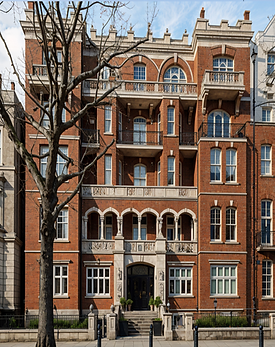
Grade II listed residential Grade II listing covers the majority of listed buildings in England and includes a very wide range of residential properties: Georgian townhouses, Victorian terraces, Edwardian villas, inter-war apartments, and mid-century structures. We work across this range — from modest period properties where the brief is to restore original features that have been obscured or damaged, to substantial residential schemes where the listed structure is being sensitively extended or comprehensively refurbished.
Conservation area properties
Properties within a designated conservation area are not listed themselves but are subject to permitted development restrictions and, in some cases, Article 4 directions that remove further permitted development rights. Changes to external appearance, extensions, and alterations to the roof line or windows typically require planning permission rather than simply being permitted. We understand the conservation area context and design within it — not around it.
Period properties: Victorian, Edwardian, and Georgian
Unlisted period properties benefit from the same approach as listed ones: an understanding of how the building was originally made and why, what later alterations have done to it, and what a sympathetic refurbishment looks like. We work with Victorian terraces, Edwardian semis, Georgian townhouses, and mid-century houses where the brief is to honour the period character while making the building work properly for contemporary life.
Hospitality and commercial in heritage settings
A boutique hotel in a Georgian building, a restaurant in a Victorian warehouse, a members' club in a period house — heritage settings impose particular constraints on hospitality fit-outs. The operational requirements of a commercial space do not disappear because the building is listed, but the way they are met has to be different. We have experience working in this overlap, where the hospitality brief and the heritage obligations have to be resolved simultaneously.


Why Phasezero
Our design direction is led by Lisa Gentile, whose training is in architecture and whose professional background spans construction management and design practice across London, Italy, and Spain. That combination — understanding how buildings are actually made alongside how they should be designed — is particularly relevant to historic restoration work, where what is specified on the drawing has to be achievable on site within the constraints of an existing structure.
We do not apply a signature style to historic buildings. We start with the building: its period, its condition, its original details, the alterations it has accumulated, and what the brief actually needs from it. The design follows from that reading. Our projects are finished to a level of care that reflects the buildings they are in, and the clients who commission them.
Our studio is based in West Hampstead, London. We work across London and the UK, and take on heritage restoration projects internationally where the scope and the relationship suit.
Working on something similar?
If you are considering a project involving a listed building, a conservation area property, or a historic structure and want to understand what is feasible before committing to anything, we are happy to have that conversation. Early-stage thinking is where good restoration projects begin.