Post-Carbon Cities: Designing Urban Spaces for a Sustainable Future
- Phase Zero
- Oct 9, 2025
- 3 min read
Updated: Nov 12, 2025
As climate change accelerates and the global demand for energy grows, cities — home to over 55% of the world’s population — are under pressure to reduce carbon emissions while maintaining livability. The concept of post-carbon cities represents a paradigm shift in urban planning, architecture, and design: it’s about creating cities that emit little to no carbon, rely on renewable energy, and harmonize with natural systems.
What is a Post-Carbon City?
A post-carbon city is one that significantly reduces or eliminates its dependence on fossil fuels. This includes:
Buildings designed for net-zero energy consumption.
Transportation systems that are fully electric or zero-emission.
Waste and water management integrated into circular systems.
Urban planning that promotes walkability, density, and mixed-use development to minimize energy use.
Unlike traditional sustainability strategies that focus on incremental improvements, post-carbon cities aim for systemic transformation — where the entire urban metabolism becomes regenerative rather than extractive.
Key Principles of Post-Carbon Urban Design
Energy-Efficient and Regenerative Architecture
Buildings are the largest source of urban emissions, often accounting for 40–50% of a city’s carbon footprint. Post-carbon strategies include:
Passive design principles: optimizing orientation, insulation, and shading to reduce energy demand.
Net-zero energy buildings: integrating solar panels, wind turbines, and geothermal systems.
Circular materials: using recycled, low-embodied-carbon, or biogenic materials in construction.
Example: The Bullitt Center in Seattle, often called the “greenest commercial building in the world,” demonstrates net-zero energy and water systems.
Sustainable Transportation Networks
Transportation contributes up to 30% of urban carbon emissions in many cities. Solutions include:
Electrification of public transport: buses, trams, and trains powered by renewable energy.
Walkable and bike-friendly streets: reducing reliance on cars while improving public health.
Shared mobility ecosystems: ride-sharing, bike-sharing, and micro-mobility infrastructure.
Design Implication: Urban designers must integrate safe cycling lanes, pedestrian-priority zones, and transit-oriented developments (TODs) to facilitate low-carbon mobility.

Urban Green Infrastructure
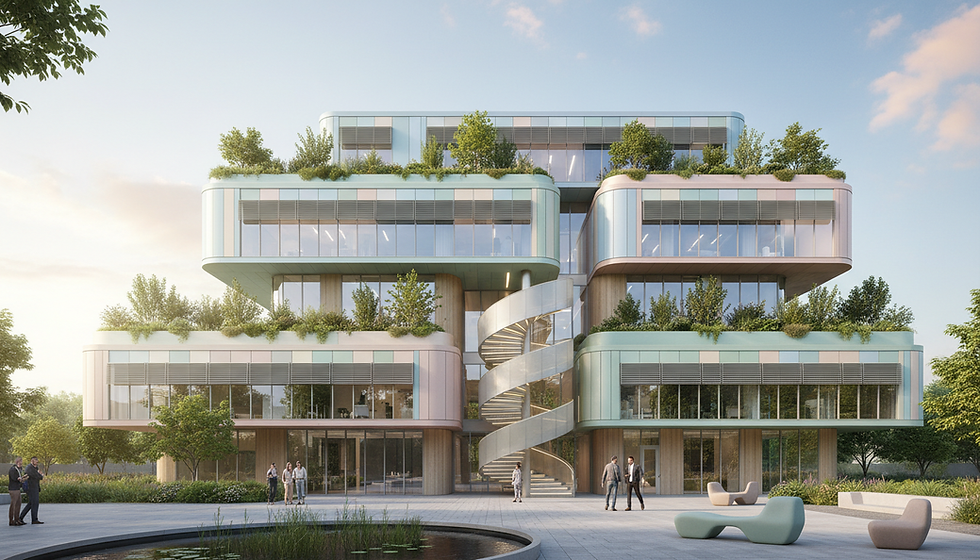
Trees, parks, green roofs, and vertical gardens aren’t just aesthetic; they are carbon sinks and climate regulators.
Urban forests and green corridors reduce the urban heat island effect.
Green roofs and walls improve insulation and reduce energy demand.
Biodiverse spaces enhance resilience against floods and extreme weather.
Design Tip: Integrate greenery early in planning to create multi-functional landscapes — recreation, stormwater management, and energy reduction all in one.
Circular Economy in Cities
A post-carbon city treats waste as a resource.
Recycling and upcycling for construction materials.
Composting organic waste to reduce methane emissions and support urban agriculture.
Water reuse systems: greywater recycling and rainwater harvesting reduce both energy and freshwater consumption.
Circular systems reduce urban carbon footprints while enhancing local resilience.
Technologies Driving Post-Carbon Cities
Smart grids and energy management: AI-powered grids optimize renewable energy usage across neighborhoods.
IoT and sensors: Track energy, water, and waste in real time to identify inefficiencies.
Carbon capture and storage (CCS): Applied in industrial zones and potentially integrated into building materials (e.g., carbon-storing concrete).
Design Insight: Architects and urban planners must collaborate with engineers and technologists to integrate these systems seamlessly into the urban fabric.

Global Examples
Copenhagen, Denmark: Aims to be carbon-neutral by 2025. Initiatives include extensive bike networks, energy-efficient buildings, and district heating.
Freiburg, Germany: A model solar city with low-energy housing, integrated public transport, and participatory urban planning.
Masdar City, UAE: Designed as a zero-carbon, car-free city, with renewable energy and sustainable building systems (though still evolving).
These examples highlight different strategies tailored to local contexts, emphasizing that post-carbon design is adaptive, not one-size-fits-all.
Challenges to Achieving Post-Carbon Cities
Retrofitting existing infrastructure: Most cities have legacy buildings and networks that require massive upgrades.
Financial constraints: High upfront costs for renewable energy systems and sustainable construction.
Behavioral change: Citizens must adopt new transport, energy, and consumption habits.
Policy and governance: Coordinated urban policies are essential to incentivize low-carbon technologies and designs.
The Role of Designers and Urban Designers
Designers and planners are crucial for translating post-carbon principles into tangible urban forms:
Masterplanning districts for energy self-sufficiency.
Designing net-zero buildings and precincts.
Incorporating public engagement to ensure social as well as environmental sustainability.
Leveraging biophilic design to reconnect urban dwellers with natural systems.
Conclusion: Towards a Post-Carbon Future
Post-carbon cities are no longer a distant vision — they are emerging realities. Through integrated planning, innovative design, and technology adoption, urban environments can drastically reduce carbon emissions while enhancing livability, equity, and resilience.
The transformation will require collaboration across disciplines, significant policy support, and a willingness to rethink how cities function. For designers, interior designers, and planners, the post-carbon city is an opportunity to reshape urban life for a sustainable, regenerative future.